Why Internet Access in China Works Differently for Travelers
Ever wonder why your phone works fine for texting from Beijing but your favorite apps just spin and freeze? China's internet runs behind the Great Firewall, which blocks or slows many foreign apps and sites regardless of which carrier you use. This changes how you need to think about both your mobile data and your connection tools before you even land.
This guide covers china esim with vpn unlimited data.
A Quick Worked Example
Say you land in Shanghai with a local eSIM giving you fast 5G data. You open your email app, no problem. But you try to check a map app from home or send a message through a blocked platform, and nothing loads.
That's not a data problem. Your eSIM is working perfectly; it's the Firewall filtering what that data can reach. Data access and content access are two separate things in China, and mixing them up is the most common mistake travelers make.
Why This Trips Up First-Time Visitors
Most people assume that buying a data plan is the whole solution. It's only half of it.
Some providers now sell a china esim with vpn unlimited data bundle to simplify this, pairing high-speed mobile data with VPN access included in one purchase. These plans often promise unlimited data after a daily high-speed cap is reached, and some lean on China's 5G and LTE networks for steady speeds.
What You Should Know Going In
Here's the thing worth remembering before your trip:
- Your eSIM handles the connection to the network.
- A VPN handles which content that connection can actually reach.
- Both need to be working together, not just one or the other.
What an eSIM Actually Does (and What It Can't Do)
So what is an eSIM really buying you? It's a digital SIM card that connects your phone to a local mobile network, like China Mobile or China Unicom, without you swapping a physical card. That's it.
It gets you data and sometimes a phone number, but it doesn't touch what you can actually reach online.
What an eSIM Handles Well
An esim for china travel setup gives you fast, reliable mobile data the moment you land, often with 5G and LTE coverage across major cities. Many plans now advertise unlimited high-speed data, which sounds great on paper. In reality, most "unlimited" plans slow down after you hit a daily high-speed cap.
Some providers bundle a VPN directly into the eSIM plan. That's convenient, but it means you're trusting one company for both your connection and your privacy tool.
What an eSIM Can't Fix
Here's the part people miss: an eSIM is just a data pipe. It cannot get you past the Great Firewall on its own. Google, Instagram, WhatsApp, and most Western news sites stay blocked no matter which eSIM you buy.
That's why you still need a separate VPN app running on your device. I've checked this setup on Windows and Android, and the eSIM and VPN really do work as two separate jobs — one gets you online, the other decides what you can actually see once you're there.
My Recommendation
Buy your eSIM for data coverage, then install a VPN app before you land, since China's app stores restrict VPN downloads once you're inside the country. Safeneon VPN works this way on Windows and Android, with a kill switch and split tunneling you can configure ahead of your trip. For a broader look at how VPN providers work before you choose one, check out this beginner's guide to VPN providers.
Why a Chinese eSIM With a Built-In VPN Rarely Exists
So which Chinese eSIM has a built-in VPN? Honestly, very few. And the ones claiming it usually mean something looser than you'd expect.
Let's break down why this combo is so hard to find, and what actually works instead.
The Common Mistake: Trusting "VPN Included" Claims
A lot of travelers search for an eSIM for China travel that already has a VPN baked in, hoping to skip a second app. Some sellers do bundle one in. Some travel listings market a China eSIM with a VPN included at no extra charge, and a few list plans that pair unlimited data with a built-in VPN.
Here's the catch: these bundles tie you to one provider's VPN, which you can't swap, test, or review closely before buying. If that VPN struggles on a given day, you have no backup plan.
The Better Way: Keep the eSIM and VPN Separate
I built Safeneon VPN and use it myself on Windows and Android every day, so I'll say this plainly: an eSIM's job is data. A VPN's job is routing that data somewhere else. Mixing the two into one product sounds convenient, but it means you're locked into whatever VPN tech that eSIM seller chose, with no visibility into how it's run.
Choosing them separately gives you control. You pick a china travel data plan from a carrier offering unlimited high-speed access on 5G or LTE, then add vpn access esim china travelers actually trust on top of it.
Safeneon currently runs on Windows and Android, with no iPhone or Mac app yet. There's a free trial with no card required, plus a 30-day money-back guarantee if it's not a fit. For honesty's sake, Safeneon isn't a zero-logs service — the full details sit at safeneon.com/logging, and it's worth a read.
Do You Need a VPN When Using an eSIM in China?
Short answer: yes, almost always. An eSIM gets you connected to a Chinese carrier network, but that network still sits behind the same restrictions as any local SIM card. Your data plan and your ability to reach blocked apps are two completely separate things.
Say you land in Shanghai with an eSIM giving you unlimited high-speed data on China's 5G network. You open your phone to check a map app or send a message home. Without a VPN, that app may just spin and never load, because the connection itself isn't the problem — what's blocked is the destination.
Now add a VPN app before your plane even lands. Same eSIM, same data plan, but suddenly those blocked apps start working because your traffic is routed differently. The eSIM handles the pipe; the VPN handles what flows through it.
Why Some Listings Blur This Line
You'll see eSIM providers advertise "VPN included" or "VPN with unlimited data" plans. Some bundle an actual VPN app with the data package, which can work fine for casual browsing. Others just mean you can install any VPN yourself after activating the eSIM — not quite the same promise.
That's worth checking before you buy, since the wording isn't always clear on marketing pages.
What I've Learned Checking This Setup
I run Safeneon VPN and use it regularly on Windows and Android, including scenarios where connection speed and reliability really matter. One thing I always tell people: install and test your VPN before you travel, not after you land, since downloading new apps can be tricky once you're already behind the firewall.
If you're newer to VPNs generally and want the basics explained simply, this beginner's guide on what a VPN provider actually does is a good starting point. And if privacy is part of your concern, it's worth reading how any provider handles your data, including our own notes at safeneon.com.
China eSIM With VPN Unlimited Data: What "Unlimited" Really Means
What does "unlimited data" actually mean when an eSIM seller slaps that word on a China plan? Good question, and the honest answer is: it depends. Most of these plans give you a chunk of high-speed data each day, and once you burn through it, your speed drops way down for the rest of that day.
It's still technically unlimited, just not unlimited at full speed.
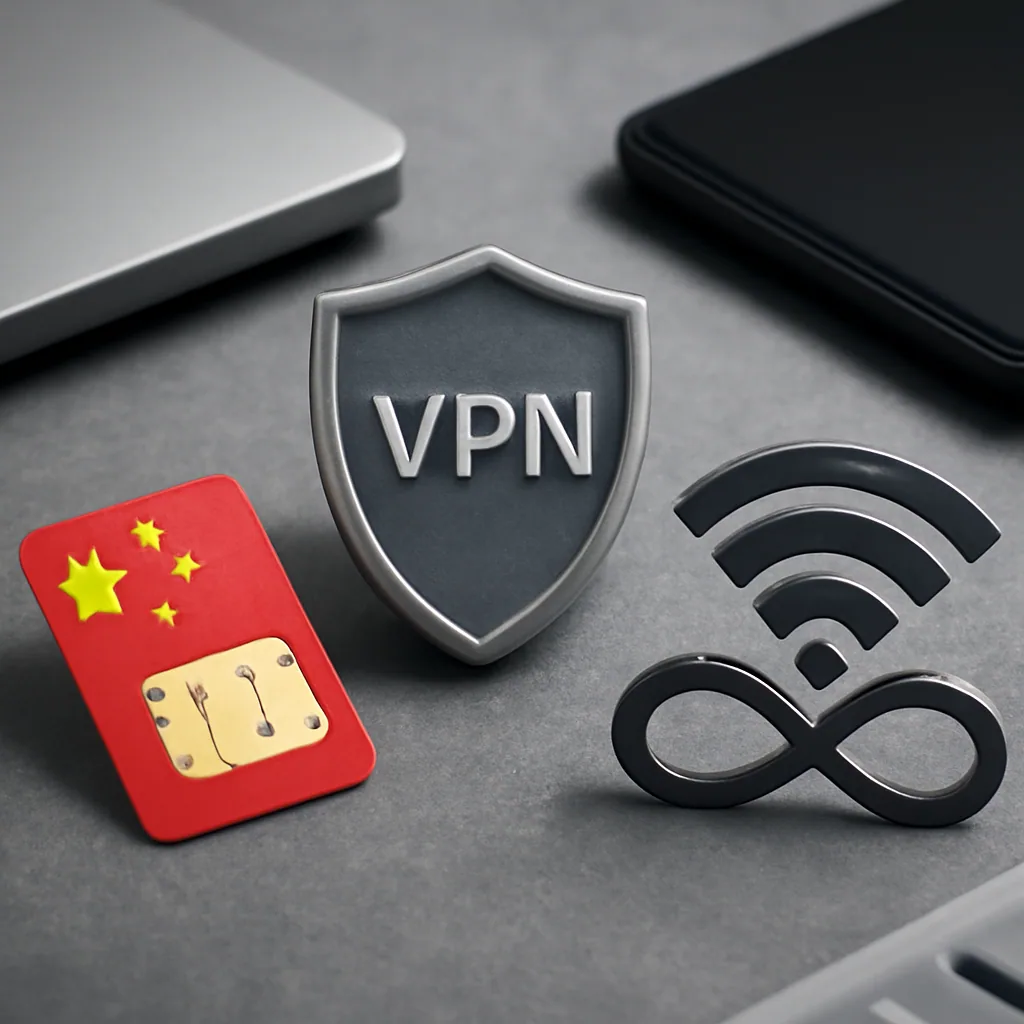
How "Unlimited" Plans Actually Work
Some providers advertise unlimited high-speed data on China's 5G and LTE networks, which sounds great on paper. In practice, you get fast data up to a daily cap, then a slower connection kicks in until the next day resets. That's not a scam.
It's just standard industry practice, and it matters when you're trying to stream or do a video call late in the day after your fast data runs out.
Some sellers go further and bundle a VPN directly with the eSIM, claiming it's included at no extra charge. That sounds convenient, but these bundled VPN tools are usually basic and built by the eSIM company, not a dedicated VPN provider. You're trusting one company to handle both your connection and your access to blocked apps, which is a lot of responsibility for one app to carry.
Why a Separate VPN Still Makes Sense
My honest recommendation, after checking connections on Windows and Android: keep your eSIM for data and pick a separate, dedicated VPN app for China access. An eSIM's job is getting you online. A VPN's job is getting you past the Great Firewall safely and consistently.
Mixing both jobs into one bundled tool often means neither works as well as it should.
How to Choose the Best eSIM for China When Paired With a VPN
Which eSIM is best for China? Wrong question, actually. The better question is which eSIM pairs cleanly with the VPN you plan to use, because that combo matters more than any single feature on its own.
Mistake: Picking Based on "Unlimited" Alone
A lot of buyers chase the word unlimited and stop reading there. Some sellers do offer unlimited high-speed data on China's 5G and LTE networks, but that word alone tells you nothing about whether a VPN will run smoothly on top of it.
A few eSIM listings even claim a built-in VPN at no extra cost, bundling it right into the data plan. That sounds convenient, but you're trusting one company for both your connection and your privacy tool, with no way to swap one out if it underperforms.
Better Way: Separate the Data Plan From the VPN Decision
Treat your esim for china travel purchase and your VPN choice as two separate decisions, then check them together before you fly. Look at the eSIM for coverage and the daily high-speed data cap, and look at the VPN for stability on China networks.
This is where I'd point to something practical: Safeneon VPN runs on Windows and Android, with a free trial that needs no card. Run it on your eSIM's data before your trip and see how it handles a video call or a map app, since that's a fair stress test for China.
Quick Checklist Before You Buy
- Confirm the eSIM covers the cities on your trip, not just "China" broadly.
- Check the daily high-speed data limit, not just the word unlimited.
- Test your VPN app on a similar network before departure.
- Read how the provider handles your data; Safeneon's own logging details are posted at safeneon.com.
Setting Up an eSIM and VPN Together Before You Land
What's the right order of operations so you're not fumbling with settings while standing in the Beijing airport immigration line? Set up both your eSIM and your VPN app before you leave home, test them on your home Wi-Fi, and only then switch your phone to flight mode for takeoff. Doing this backward is the single biggest mistake I see travelers make.
The Setup Order That Actually Works
Install your eSIM profile first, since most providers require an internet connection to activate it, and you won't have reliable access once you're in China. Right after that, download your VPN app and log in while you still have normal access to app stores and websites.
Here's a quick example. Say you install your China eSIM at home, then open the Safeneon VPN app on your Android phone and connect to a server before boarding your flight. When you land and switch your eSIM data on, the VPN should reconnect automatically, because you already saved your login and picked a preferred server.
Why Testing Before You Land Matters
Some eSIM China travel plans advertise unlimited data, but speeds often slow down after you hit a daily high-speed cap, then continue at a reduced rate. Pair that with a VPN connection, and a slow eSIM plus a struggling VPN app makes for a frustrating first day abroad.
One Setting Worth Checking First
Turn on auto-connect on public Wi-Fi if you're on Android, since airport and hotel networks in China are shared and often unsecured. It's a small setting, but it means your VPN activates without you remembering to tap anything. For more on how VPN providers structure their apps and settings, this beginner's guide to VPN providers covers the basics clearly.
Getting an eSIM With a Local Phone Number Plus VPN Access
Can you actually get a Chinese phone number, data, and VPN access all in one package? Sort of. Some eSIM providers now bundle a local number with data plans, and a few even advertise a VPN tucked into the deal.
But before you get excited, let's sort out what's real and what's marketing.
Why the Phone Number Part Matters
A local number lets you sign up for apps that ask for SMS verification, like ride-hailing or food delivery services common in Chinese cities. Some travelers also use it so hotels or local contacts can text them directly. It's a nice extra, but it has nothing to do with whether your VPN will work once you land.
Why I Keep VPN Separate From the eSIM
Here's my honest take as someone who runs VPN apps daily: bundled "VPN included" eSIM offers often mean a basic, limited tool, not something built for the kind of steady access travelers actually need. I'd rather you pick an eSIM purely for the data and number, then install a dedicated VPN app you control and can troubleshoot yourself.
That's also why I tell people to treat the phone number as a bonus feature, not the main event. Your connection quality depends almost entirely on the VPN app, not the SIM.
Get an eSIM for china travel that includes a local number if you want the convenience, but download Safeneon VPN separately on your Windows laptop or Android phone before you fly. Right now, Safeneon doesn't have an iPhone or Mac app, so plan around that if you're an Apple user. You can try it free, no card required, and there's a 30-day money-back guarantee if it doesn't suit your trip.
This separation gives you more control. If the eSIM's bundled VPN slows down or drops, you're not stuck. For background on how VPN providers actually work, this beginner's guide to VPN providers walks through the basics in plain language.
What People on Reddit Say About China eSIM and VPN Combos
That's one of the most common questions floating around travel forums, and honestly, it's the wrong place to look for answers. Reddit threads about China travel are full of secondhand stories, outdated screenshots, and advice from one trip five years ago.
Let's sort through what's actually useful.
The common mistake: trusting "it worked for me" posts
A lot of threads claim a certain eSIM came bundled with VPN access and worked perfectly the whole trip. Some sellers do pair an eSIM with VPN access as part of the package. But "worked for me" in a Reddit comment from eight months ago doesn't guarantee anything today, since China's network filtering shifts without warning.
The better way is to treat every forum tip as a starting point, not a guarantee. Check if the provider still offers the same setup, read recent comments instead of top-voted old ones, and confirm the VPN app itself gets regular updates.
The better way: separate the data question from the VPN question
Most useful Reddit threads eventually land on the same split: buy an eSIM for data and connectivity on a network like China Mobile or China Unicom, and handle app access separately with a VPN you install and test before leaving. Plenty of China eSIM plans now advertise unlimited high-speed data on 5G and LTE networks, which solves the connectivity half.
For the access half, I'd rather you test a VPN at home first. With Safeneon VPN, there's a free trial with no card needed, so you can check how it behaves on Windows or Android before you ever land in Beijing. We're upfront that Safeneon isn't a zero-logs service — the honest details are on the privacy and logging policy page.
Skip the forum guesswork. Test the tools yourself, then trust your own results over anyone's old thread.
Free eSIM and VPN Offers for China: What to Watch Out For
Seen an ad promising a free China eSIM with a VPN tossed in for nothing? Be careful. Free bundles like this almost always cut corners somewhere, whether that's data speed, device support, or actual access once you land.
The "Free" Catch
Here's a worked example. Say a site offers a "free eSIM with unlimited data and VPN for China." You sign up, get a tiny data allowance (maybe 500MB to 1GB), and the VPN part turns out to be a basic proxy that stops working after a day or two in Beijing or Shanghai.
Some providers do bundle a VPN with their China eSIM at no extra charge, and a few plans genuinely include unlimited data after a daily high-speed cap. But "free" and "included" aren't the same thing. One is a real feature baked into a paid plan; the other is bait.
Questions to Ask Before You Trust the Offer
- Does the VPN app actually run on your phone's operating system, or just on desktop?
- Is there a real company behind it with a support page, or just a download link?
- What happens to your data and browsing history? Check if the provider is upfront about logging, the way Safeneon VPN is at safeneon.com and in its privacy and data protection guide.
- Can you cancel easily, or are you locked into a subscription you didn't expect?
A Safer Starting Point
Instead of chasing a totally free bundle, look for a trial that doesn't require a card upfront. Safeneon VPN offers a free trial with no card needed, plus a 30-day money-back guarantee if you go with a paid plan afterward. Note that Safeneon currently has apps for Windows, Android, and Chrome only — no iPhone or Mac app yet, so plan your devices accordingly before your trip.
Using a China eSIM With VPN on Android Devices
Does Android make this easier or harder than other phones? Easier, actually. Android gives you more control over connection settings, which matters when you're juggling a China eSIM and a VPN app at the same time.
Most newer Android phones support eSIM, and the setup process is pretty simple once you know the order of operations. You install the eSIM profile first, confirm it connects to a Chinese carrier network, then install your VPN app before you land. Waiting until you're in China to download a VPN app is a mistake — most VPN provider websites and app stores are themselves blocked once you're behind the firewall.
Why Android Works Well for This Setup
Safeneon VPN runs as a native Android app, so it installs and connects the same way any other app does. There's no Mac or iPhone app yet, which is worth knowing if your travel group uses a mix of devices.
On Android, you can also turn on auto-connect for public Wi-Fi, so the VPN fires up automatically the moment you join a hotel or airport network. That's one less thing to remember while you're dealing with jet lag and a new SIM profile.
What to Check Before You Travel
A few things matter more on Android specifically:
- Confirm your phone model supports eSIM and dual-SIM mode, since not every Android device does.
- Download and test your VPN app while still on home Wi-Fi, not after switching to the China eSIM data.
- Check that split tunneling is set up correctly, so apps needing local access aren't accidentally routed through the VPN.
Some sellers advertise an esim for china travel with a built-in VPN, claiming it skips this whole setup process. In practice, most of these still rely on a separate VPN app installed on your phone, Android included. If privacy details matter to you, Safeneon publishes its logging practices openly at safeneon.com, and it's worth a look before you commit to any provider for a China trip.
Booking Platforms, Travel Apps, and eSIM Bundles for China Trips
Should you buy your eSIM straight from a travel booking site, or keep that purchase separate from your VPN? It's a fair question, since so many travel apps now bundle flights, hotels, and connectivity in one checkout. The short answer: bundling is convenient, but it's not always the smartest setup for privacy or control.
The Bundle Mistake
Some travel platforms sell China eSIM plans that advertise a built-in VPN as part of the package. Other sellers pitch the same idea — a China eSIM with VPN included at no extra cost. Some lean more on the unlimited data angle, promising seamless 5G and LTE access without mentioning VPN tools at all.
The mistake here is assuming "bundled" means "better." When a VPN is baked into a data plan, you usually can't choose your server city, check device limits, or read a real logging policy. You're trusting a travel app to also be a privacy tool, and those are two very different jobs.
The Better Way
Buy your eSIM for data. Buy your VPN for access and privacy. Keep them separate, and you control both pieces independently — which matters if one stops working mid-trip.
This is exactly how I run things day to day checking Safeneon VPN on Windows and Android. I'd rather manage a dedicated VPN app than hope a bundled travel feature updates its servers on time.
If you want a plain-English explainer on how VPN providers actually work before you shop around, this beginner's guide to VPN providers is a solid starting point. Safeneon itself runs on a free trial with no card required, plans from Basic to Dedicated IP, and a 30-day money-back guarantee — details on logging practices are posted openly at safeneon.com, including the logging page.
| Approach | What You Control | Risk |
|---|---|---|
| Bundled eSIM + VPN (travel app) | Little — f | Limited flexibility and less visibility |
| Separate eSIM + VPN | More — you can choose each piece | You need to set up both before travel |
Conclusion
So where does this leave someone planning a trip to China? Pretty much back at the same conclusion every section above has pointed to: an eSIM handles your connection to a local carrier, and a VPN handles getting past the Great Firewall, and treating them as one magic bundle usually leads to disappointment. "Unlimited data" sounds great on a landing page, but read the fine print before you commit.
The data plan matters, sure, but the VPN you pair it with matters more, since that's what decides whether your maps load, your messages send, and your video calls actually connect once you land. Reddit threads and flashy ads won't give you a reliable answer here. A dependable VPN app, tested and stable on both Android and iOS, will.
Safeneon VPN is built with exactly this kind of travel scenario in mind, pairing well with most China eSIM data plans so you're not left guessing whether your connection will hold up once you're behind the firewall. Set it up before you fly, test it at home, and you'll skip the stress of troubleshooting from a hotel lobby in Shanghai. Good preparation beats scrambling every time.
Try Safeneon VPN free – no card needed.
Key Takeaways
- China's Great Firewall blocks foreign apps regardless of eSIM provider or carrier choice.
- An eSIM only connects you to a local network; it does not bypass internet restrictions.
- Few Chinese eSIMs genuinely include a built-in VPN despite marketing claims suggesting otherwise.
- Pairing an eSIM with a separate, reliable VPN remains necessary for accessing blocked sites.
- "Unlimited data" often means capped high-speed data followed by throttled speeds afterward.
- Install, configure, and test both eSIM and VPN before departing for China.
- Free eSIM and VPN bundles frequently compromise on speed, security, or reliability.
Expert Quotes
An eSIM gets you connected to a Chinese carrier network, but that network still sits behind the same restrictions as any local SIM card, which is why a VPN remains necessary for accessing apps and services blocked within China. Do You Need a VPN When Using an eSIM in China?,, us.trip.com
A Chinese eSIM with a genuinely built-in VPN is rare, and providers claiming this combination usually mean something looser than travelers expect, so understanding what the plan actually offers matters before relying on it in China. How to Get a China eSIM with VPN? Best 5G Data Plans,, us.trip.com
FAQ
1. Which Chinese eSIM has a built-in VPN?
Some eSIM providers marketed for travel to China bundle a VPN app or VPN-like connectivity feature alongside the data plan, so you don't need to install and configure a separate VPN service yourself. These combined plans are designed to let you access blocked platforms like Google, WhatsApp, Instagram, and Facebook as soon as you land, without hunting for a working VPN app once you're already behind the firewall. Not every eSIM offers this, though.
Many standard eSIMs only provide mobile data and leave VPN access entirely up to you. If staying connected to Western apps matters, look specifically for a plan that advertises VPN access as part of the package, rather than assuming any eSIM will unblock those sites automatically.
2. Do you need a VPN when using an eSIM in China?
Yes, in most cases. China's internet restrictions, often called the Great Firewall, block access to many foreign apps and websites regardless of which SIM or eSIM you're using. An eSIM alone, even one from an international provider, typically won't bypass these restrictions unless it's specifically paired with VPN functionality.
If you rely on apps like Gmail, Google Maps, social media, or messaging services that are blocked in China, you'll need either a standalone VPN app installed before you arrive or an eSIM plan that includes VPN access built in. Without one or the other, you may find yourself unable to reach the apps you use daily.
3. Which eSIM is best for China?
The best choice depends on what you need most: pure data speed, coverage across the whole country, or built-in access to blocked apps. For travelers who mainly want seamless access to Western apps without extra setup, an eSIM that bundles VPN access tends to be the most convenient option. For those who already have a reliable VPN installed and just need solid mobile data, a plan focused on network coverage and data allowance might be enough.
It's worth comparing data limits, validity periods, and whether the plan explicitly mentions VPN or unblocking features before deciding.
4. Does VPN Super Unlimited work in China?
Results can vary. China's internet censorship system actively works to detect and block VPN traffic, and it updates its methods often, so a VPN that works reliably in other countries may struggle to maintain a stable connection inside China. Some VPN services are built with obfuscation techniques meant to get around this kind of detection, while others are not.
Before traveling, it's worth checking whether the specific VPN service has a track record of functioning inside China, and downloading and testing it before you depart, since app stores and VPN provider websites are often inaccessible once you're already there.